At a glance
- Mohammed Bin Rashid University of Medicine and Health Sciences (MBRU) was in search of a digital assessment software for its newly established College of Medicine — one that could provide a solid foundation for a variety of assessment types and in-depth reporting where other solutions fell short.
- The College of Medicine adopted ExamSoft in 2017 to deliver both formative and summative written assessments as well as Objective Structured Clinical Examinations and Multiple Mini Interviews.
- To support flexible instructional needs and expanding enrolment, ExamSoft provided the features the College needed to administer secure, offline assessments anywhere, while optimising the remote admissions process.
Background
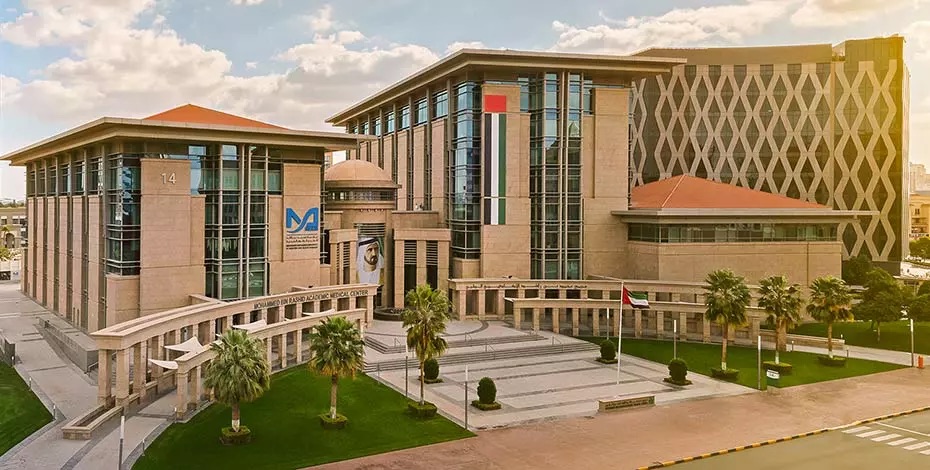
Founded in 2016, Mohammed Bin Rashid University of Medicine and Health Sciences (MBRU) is the first medical university within Dubai Healthcare City (DHCC), a healthcare-focused economic free zone hosting leading international organisations such as Johnson & Johnson, the UK’s Moorfields Eye Hospital, and South Africa’s Mediclinic International.
MBRU’s College of Medicine (COM) currently offers two programmes — a Bachelor of Medicine and Bachelor of Surgery (MBBS) and a Master of Science in Biomedical Sciences (MSBS). The MBBS is a six-year undergraduate programme that offers students valuable clinical experience from Year 1 through on-campus research and affiliations with local and international healthcare institutions.
Challenge
As IT Manager at MBRU, Jalal Mohamadeya is responsible for researching and initiating most of the technology solutions currently in use at the university. In 2015, when MBRU was still in its infancy and its College of Medicine had yet to receive its first cohort, Jalal was tasked with finding a digital assessment tool that could keep pace with the growing university.
Eliminating paper-based exams was a major goal in Jalal’s search for a digital assessment platform. He wanted to reduce printing costs and boost faculty efficiency in creating and scoring exams. MBRU also required a solution that offered more advanced reporting tools than their learning management system could provide, including exam blueprinting and psychometrics for analysing the quality of exams and exam items.
In addition to meeting these criteria, MBRU hoped to find a solution with rubrics-based tools for assessing the clinical competence of future COM students in Objective Structured Clinical Examinations (OSCEs) and Multiple Mini Interviews (MMIs).
Adoption and implementation
Jalal first learned about ExamSoft in 2015 while attending the EDUCAUSE Annual Conference in Indianapolis. When MBRU’s College of Medicine received its first cohort in 2016, Jalal contacted ExamSoft to discuss implementation and the platform was formally adopted in 2017.
To ensure a smooth experience, an ExamSoft implementation specialist visited MBRU to train faculty members and staff to build and manage assessments within the faculty portal and to familiarise them with Examplify, the student-facing exam application.
In spring 2017, COM piloted its first exam with ExamSoft. The following year, COM began using ExamSoft’s rubrics-based tool to evaluate students’ performance in clinical scenarios with OSCEs. COM also launched its pilot MMI programme in 2018, using ExamSoft to score and rank prospective COM candidates in the admissions process. These MMIs assess the “soft skills” of each candidate, including communication skills, ethical reasoning, empathy, and problem-solving, to ensure that candidates not only meet the rigorous academic requirements of the programme, but are competent in non-cognitive areas as well. This initiative was well-received, earning the MBRU MMI Team the “MBRU Excellence Award 2020 – Innovation.”
Results
As the COM worked to digitise programme curricula, some faculty were resistant to the change. Faculty members, accustomed to face-to-face interactions with students, were worried that student access to exam results would limit their ability (or eliminate the need) to provide meaningful post-exam feedback, which would hinder student remediation. However, faculty soon found that the time saved in building and grading assessments allowed them to dedicate more time to enhancing their course, thus improving student learning outcomes.
With ExamSoft’s item analysis and psychometrics tools, COM faculty have been able to evaluate overall exam quality and glean statistical insights related to specific items to determine question quality. Leveraging these statistics, faculty can observe whether their exams are effectively measuring student knowledge and decide whether individual questions have a place in future assessments.
Since successfully delivering its first high-stakes exam in autumn 2017, the College of Medicine has made Examplify a core part of the student experience, allowing it to completely eliminate paper-based exams.
COM faculty are now equipped to write their own items, create and deliver assessments, and even implement new question types. However, Jalal and his colleagues in the Smart Services department still offer ExamSoft consultation and training. In fact, Jalal earned the ExamSoft Power User Certificate in May 2019, making him a very knowledgeable resource for MBRU faculty. When faculty want to introduce new assessment modes and methods in their courses, COM’s IT department assists by directing pilot programmes for these courses.
The college has utilised ExamSoft’s category tagging and reporting tools to prepare for yearly visits from the UAE Ministry of Education’s Commission for Academic Accreditation (CAA). By using question tagging, ExamSoft’s curriculum mapping tool, COM has created an exam blueprint, which outlines a hierarchy of competencies from course to programme, programme to college, and college to university. COM is able to quickly generate these reports to demonstrate how they are measuring course objectives and learning outcomes at the course, programme, and college level.
Flexible and remote assessment
As MBRU expanded its academic programs and attracted applicants worldwide, the university needed an assessment strategy that could extend beyond physical classrooms without compromising security or academic integrity.
To support secure, off-campus testing and flexible delivery, the College of Medicine turned to ExamSoft and its ExamID and ExamMonitor solutions. The combination of auto-identity verification and AI-powered remote proctoring for its MBBS program enabled the COM to securely deliver end-of-semester exams wherever students were located.
With ExamID and ExamMonitor, COM faculty can now verify the identity of each student prior to accessing exams, and review flagged behaviors during exam sessions, to easily determine if academic misconduct has occurred.
To maximize flexibility and accessibility for prospective students, MBRU extended its MMI program across university-wide admissions. By introducing a Teams conferencing tool to accompany rubrics through ExamSoft, MBRU has optimized the screening process for prospective candidates. Since MBRU can schedule time to meet with prospects anytime and anywhere in the world, the university is able to interview more candidates and thus enroll a larger, more diverse student body. Though MMI scenarios vary across colleges at MBRU, ExamSoft is flexible enough that it can be effectively used by all to score and rank applicants.
A future-proofed assessment strategy
The College of Medicine has demonstrated the ability to deliver both on-campus and remote assessments using ExamID and ExamMonitor, depending on instructional needs. ExamID supports a streamlined process for on-site exams, while remote proctoring capabilities remain available to support secure, remote assessment when required.
Moving forward, the College of Medicine feels confident that ExamSoft’s solutions will offer the flexibility it needs and continue to deliver high-quality assessments.