Online checklist
Is your exam security ready for AI?
A 7-point checklist for today's academic leaders
AI has fundamentally changed the rules of exam security. Old security methods are no longer enough.
Use this checklist to self-assess your institution's readiness and identify the new, critical vulnerabilities you may be overlooking.

1. The threat has evolved. Have your defenses?

Do you have a clear understanding of how students can use AI to cheat?
It's no longer about simple web searches. AI provides instant, accurate answers for any question type and is smart enough to pass graduate-level exams.
2. Is your security prepared for browser-level AI?
Is your security strategy prepared for native browser extensions and helpers that create new cheating opportunities?
Institutions are now fighting on two fronts: apps designed for cheating and "big tech" tools. These built-in browser tools aren't meant for cheating but are easily misused, automatically updated, and can't be easily controlled by instructors.
3. Is your security prepared for OS-level AI?
Is your exam security strategy ready for AI embedded directly in the operating system (like Microsoft Copilot)?
The threat has now moved beyond the browser to the OS itself. Like the browser-level tools, these native OS functions leave institutions caught off guard and are not easily switched off.
4. Can your security stop an AI agent?
Does your security account for AI agents that can take control of the device?
Traditional exam security like lockdown tools are no longer enough. AI agents can be prompted to take control of a student’s mouse and keyboard to complete tasks, such as acing a test directly in your LMS.
5. Are you consistently reacting to new cheating and other academic integrity issues?
Does your exam security eliminate the opportunity to cheat, rather than just reactively blocking known apps and websites?
Rather than chasing constantly emerging browser features, OS-level tools, and apps specifically designed for cheating, an effective strategy removes the opportunity for threats to exist, and introduces a sustainable approach to academic integrity.
6. Can you guarantee a true measure of student knowledge?
Can you say with confidence that your student’s exam results are a true gauge of subject mastery?
Without proper exam security, institutions risk inaccurate data, reputational damage, financial strain from misconduct, and graduating unqualified professionals.
7. You've locked down the browser. But is it offline?
Does your current exam security platform function without an internet connection?
This is the most critical question. Nearly all digital exam platforms share the same architectural flaw: they require an internet connection. Because generative AI models also require the internet to work, this connection creates a permanent backdoor for AI that puts the value of your degrees at risk.
Did you answer "no" or "I don't know" to any of these questions?

Your institution may be at risk. It's time to re-evaluate your exam security strategy and neutralize online threats without the endless chase of trying to protect against every new AI tool.
The solution: Disconnect to protect
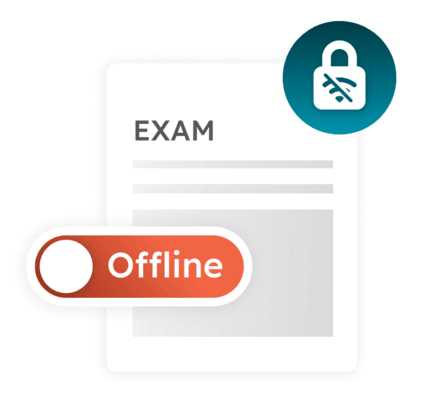
By delivering a digital exam completely offline, you close the backdoor that students use to cheat with AI.
ExamSoft by Turnitin is the only platform that offers this unique, fully offline model, providing a truly secure environment for your most important assessments.
It's time to close the AI-sized gap in your exam security.